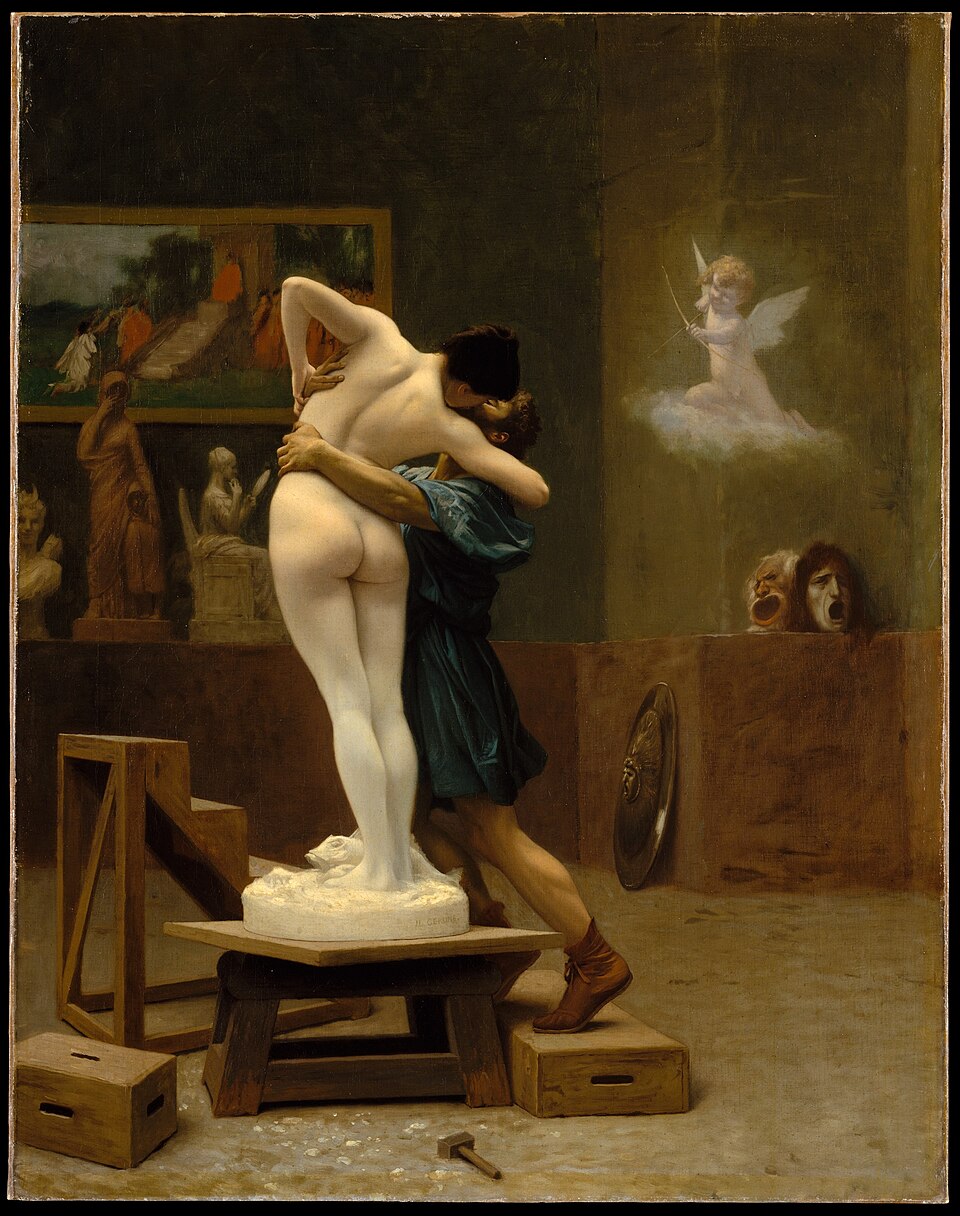
This incredibly stunning painting entitled Pygmalion and Galatea by Jean-Léon Gérôme was created circa 1890.
The painting takes its inspiration from the classical poem Metamorphoses by Ovid. In the poem, Pygmalion witnesses the propoetides (the daughters of Propoetus; women from Amathus, Kypros ancient Greece) prostituting themselves in retaliation and defiance of the Goddess Aphrodite. Pygmalion was so disgusted and upset by witnessing the deplorable acts of these women that he passionately swore to uphold a life of celibacy from thence on.
Pygmalion was a skillful sculptor from Cypros. Using marble alabaster, he sculpted the likeness of a woman so beautiful that he fell in love it and dearly wished it to be true and not a fabrication of his own hands. He expressed his affection for the sculpture by kissing it, bringing it gifts and even went as far as to provide bedding arrangements in which a living person would find enticing. He was taking care of it as if it was not just a likeness of a female but if it were genuinely human.
The annual celebration for Aphrodite eventually came along and Pygmalion brought tidings and gifts to the altar. He prayed desperately but was too embarrassed and ashamed to honestly admit his sincerest desire to bring the sculpture to life. Rather, he prayed that the Goddess would provide him with a wife with the likeness of his sculpture.
Returning home and feeling dejected he kissed his sculpture and to his surprise he sensed that the lips were no longer cold and defensive as marble but were the soft lips of a living woman. Aphrodite had indeed answered his hidden prayer after all.
Jean-Léon Gérôme captured this scene with an incredible sense of romance and detail. Once you know the story of Pygmalion it is very clear what the painting depicts. Cupid the God of desire and attraction is painted softly on the wall to the back right of the featured couple. Perhaps he, being the son of Aphrodite, was sent to execute the blessing.
This extravagant oil painting which measures thirty-five inches in length by twenty-seven inches width can be viewed in the Metropolitan Museum of Modern art.
About the artist: Jean-Léon Gérôme was born in eighteen-twenty-four in Vesoul, France. He died of natural causes at the age of seventy-nine. He was born in the era of academicism; he detested impressionism. He was commissioned by Napoleon III to paint his uncle in his expedition to Egypt. In total he made 456 artworks.
If we take a closer look at the painting focusing on the symbolism and technical attributes, we will find that the painting is a literal representation of a scene from Ovid’s Metamorphoses.There seems to be no hidden allegories. The artist had made an idealistic and very academic approach to the painting. Academic in the sense of the style of painting. Being born in the era of Academicism (1560-1900), the artist was heavily influenced by the time in which he had lived. You can see that the painting is idealistic and romantic. The brush work is meticulous, there is a balance and harmony in the muted colours. The values are dark but not overly so. The studio in which the subjects are placed seems to be from ancient times because of the other smaller classical sculptures, the bronze shield and clothing also hint at the time period. The very fact that the portrait depicts Ovid’s tale is an obvious giveaway because he died in 17AD having written Metamorphoses circa 8AD. Therefore, this was not meant to depict a couple in the age in which the artist had lived but exactly the era that the story originates from.
Although it is not entirely certain but the author of this essay suspects that this painting was not commissioned by a patron. Gérôme seemed to have a penchant for this particular story and in the background of his self-portraits you can see similar paintings depicting the tale. Thus, he most likely made it for himself. He made multiple portraits of this scene, but each individual painting views the subjects from a different angle. The most well-known version belonging to the metropolitan museum of modern art. The other is privately owned and depicts the subjects from the front rather than the back and was last sold in 2019 for $300,000. That version does not have an image of a ghostly translucent cupid and seems to be more impressionistic rather than academic, you can tell by the obvious brushstrokes and neither of the couple have recognizable faces they are obscured and unidentifiable. This is unusual because as stated earlier Gérôme was not a fan of that art style.
The author’s personal response to this artwork is that it is a beautiful literal representation of Ovid’s classic story. The author enjoys the soft muted baroque like tones of the painting. The sage green that takes up most of the painting is a superb choice of background colour. The poses of the subjects are very dynamic. The woman looks as though she may be a classical ballet dancer. The gradient and subtle change between marble and flesh is impressive from cadmium white to soft flesh tones. This is interesting because Gérôme was also gifted at polychromy, which is the art of painting sculptures and ceramics. There is great form, shape and movement. The composition is excellent because it clearly focuses on the couple while allowing you to notice the background. The direction line of cupids arrow momentarily about to be released from its bow points with accuracy. This instinctively draws your attention back to the enduring couple. While it features a man and woman romantically embracing it is not banal, crass or anyway related to grotesque eroticism. The only thing that could be considered disturbing is the actual story behind the image or the masks with expressions of pain leaning against each other in the background.
Gérôme certainly makes the audience empathize with Pygmalion. Capturing the sculptor’s moral dilemma: Urning for a romantic partner but being withheld by moral standards then by the grace of divinity having joyous relief from the horrors of self-imposed isolation.
Bibliography:
The J. Paul Getty Museum. “Understanding Formal Analysis.” Getty.edu, 2019, http://www.getty.edu/education/teachers/building_lessons/formal_analysis.html.
““Pygmalion and Galatea” by Jean-Léon Gérôme.” History Hit, http://www.historyhit.com/culture/pygmalion-and-galatea-by-jean-leon-gerome/.
“Jean-Léon Gérôme (the J. Paul Getty Museum Collection).” The J. Paul Getty Museum Collection, http://www.getty.edu/art/collection/person/103JW1.
Marchione, Sarah. “An Analysis of Jean-Léon Gérôme’s Pygmalion and Galatea from a Feminist Critical Perspective.” Art and Art History Presentations, 22 Apr. 2021, digitalcommons.ursinus.edu/art_pres/5/.
“Pygmalion and Galatea.” Metmuseum.org, 2020, http://www.metmuseum.org/art/collection/search/436483.
“P. Ovidius Naso, Metamorphoses, Book 10, Line 243.” Tufts.edu, 2019, http://www.perseus.tufts.edu/hopper/text?doc=Perseus%3Atext%3A1999.02.0028%3Abook%3D10%3Acard%3D243.
Marion, Faith. “Chapter 3 – Jean-Léon Gérôme.” Openeducationalberta.ca, Pressbooks, 2022, pressbooks.openeducationalberta.ca/19thcenturyart/chapter/jean-leon-gerome/. Accessed 25 Sept. 2024.
“Forbidden Love in Ovid’s Metamorphoses: An Analysis of the Pygmalion Myth – Dawson English Journal.” Www.dawsonenglishjournal.ca, http://www.dawsonenglishjournal.ca/article/forbidden-love-in-ovids-metamorphoses-an-analysis-of-the-pygmalion-myth/.
“The Daughters of Propoetus.” Myth on the Web, 10 Dec. 2020, mythontheweb.wordpress.com/2020/12/09/the-daughters-of-propoetus/.
“Jean-Léon Gérôme (French, 1824-1904), Pygmalion et Galatée, Esquisse à l’Huile | Christie’s.” Christies.com, Christie’s, 2020, http://www.christies.com/en/lot/lot-6199649. Accessed 25 Sept. 2024.